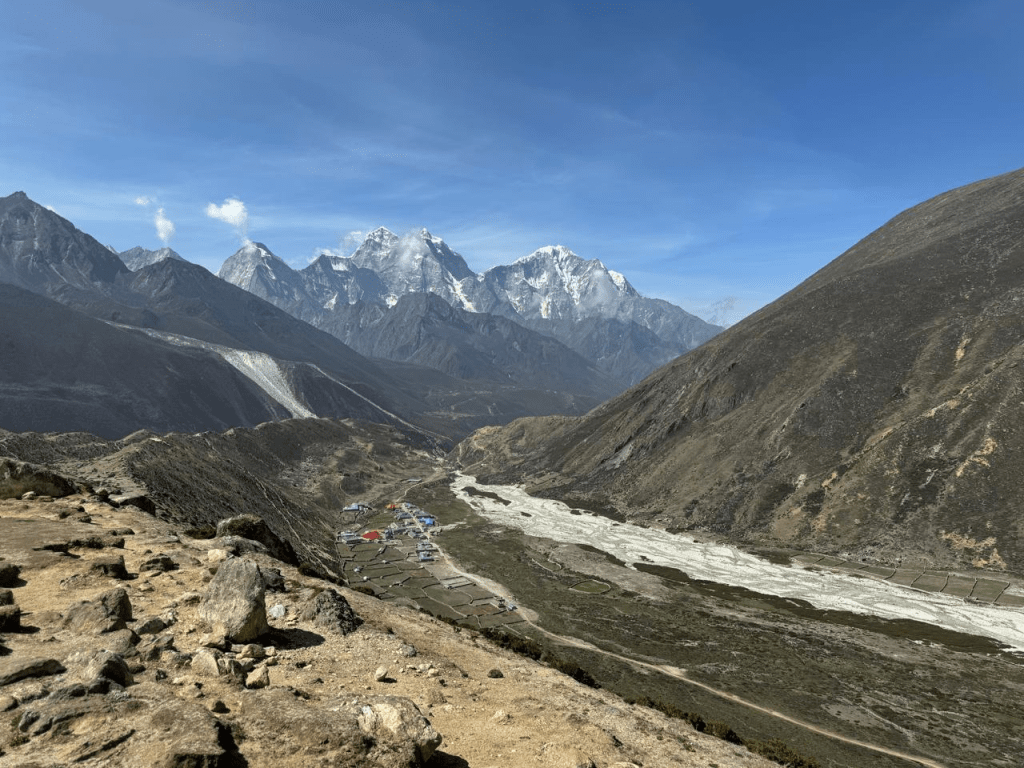
Waking up on Day 7 of our Everest Base Camp trek in Dingboche felt different from the previous mornings. There was an unspoken tension in the air, the kind that comes when you know you’re crossing another threshold, both physically and mentally. We were now above 4,500 meters, and the altitude was beginning to make its presence felt. The thin, crisp air filled with cold mountain breeze reminded us of the challenges ahead, but it also filled us with a sense of wonder. Our path was now leading us deeper into the heart of the Himalayas, and the towering peaks of Ama Dablam, Thamserku, and several other Himalayan giants were our steadfast companions, offering both inspiration and a reminder of the forces we were up against.
As we set off in the early hours, we headed toward the first flag point on Nagkartsang Hill, which we went up the previous day. From there, we turned toward the route leading us to Pheriche, marking the beginning of our trek to Lobuche. It was a journey that would take us over rugged terrain, through remote landscapes, and across some of the most humbling experiences of the trek.
The Path Less Traveled
The trail felt quiet as we set out, only the sound of our boots crunching against the rocky ground and the occasional distant call of a bird to break the stillness. The initial stretch was relatively gentle, a welcome change from the steep ascents we had tackled on previous days. As we walked, I found myself reflecting on the journey so far. Each step felt like a small victory, not just in terms of distance covered, but in the quiet battles of endurance, determination, and mental fortitude that had accompanied every climb and descent.
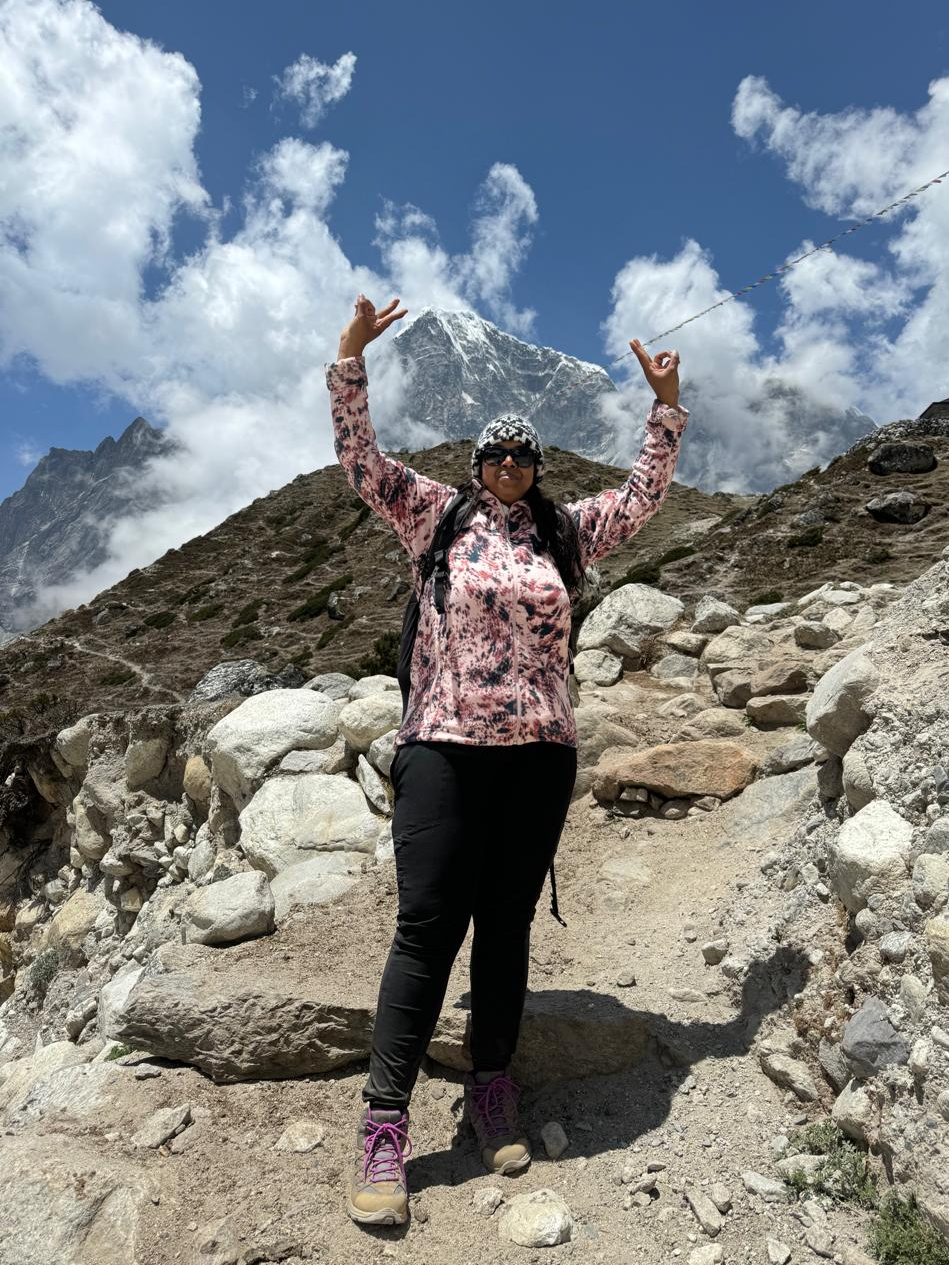
As the morning progressed, we crossed a river bridge suspended over a wildly rushing river just a few feet below us, the water foaming and roaring with the power of the mountains behind it. Crossing such bridges always stirred a mix of exhilaration and nervousness in me, but as I reached the other side, I felt a sense of accomplishment, as if the bridge was a metaphor for the journey itself – treacherous but worth every bit of the effort. We stopped at a small café for lunch. It was one of those simple yet unforgettable moments – a modest meal in a modest place, but surrounded by the grandeur of the Himalayas. I had Tomato soup with some potato wedges that fueled me for the tough climb ahead. The conversation over lunch was light, filled with laughter and camaraderie, as we met and exchanged stories with fellow trekkers, including a group of Brit hikers who had returned from the same path we were heading towards.
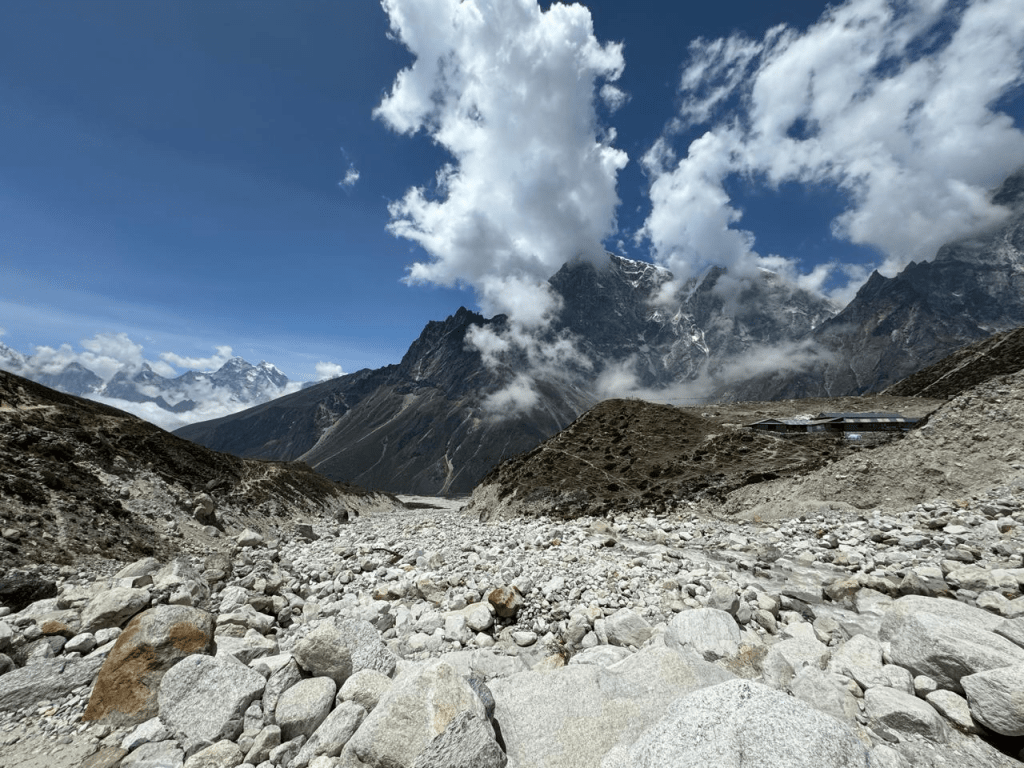
The trek was a shared experience, not just with our own group but with the countless other adventurers who had come from all corners of the world, each with their own story, their own reason for taking on this journey. There was a palpable sense of unity – the kind of bond that forms when people face the same hardships and chase the same dreams.
The Ascent to Thukla Pass and the Memorial Hill
After lunch, we set off once again, the path leading us toward Thukla Pass. The trail began to incline gradually, and soon we found ourselves in a steady climb toward Dhugla. The landscape around us was becoming more and more barren, as if the earth itself was shedding its layers the higher we climbed. Gone were the trees, the scrubby bushes, and the multitude of colorful prayer flags that had lined our paths in the lower valleys. Now, it was just rocks, boulders and the ever-present mountains.
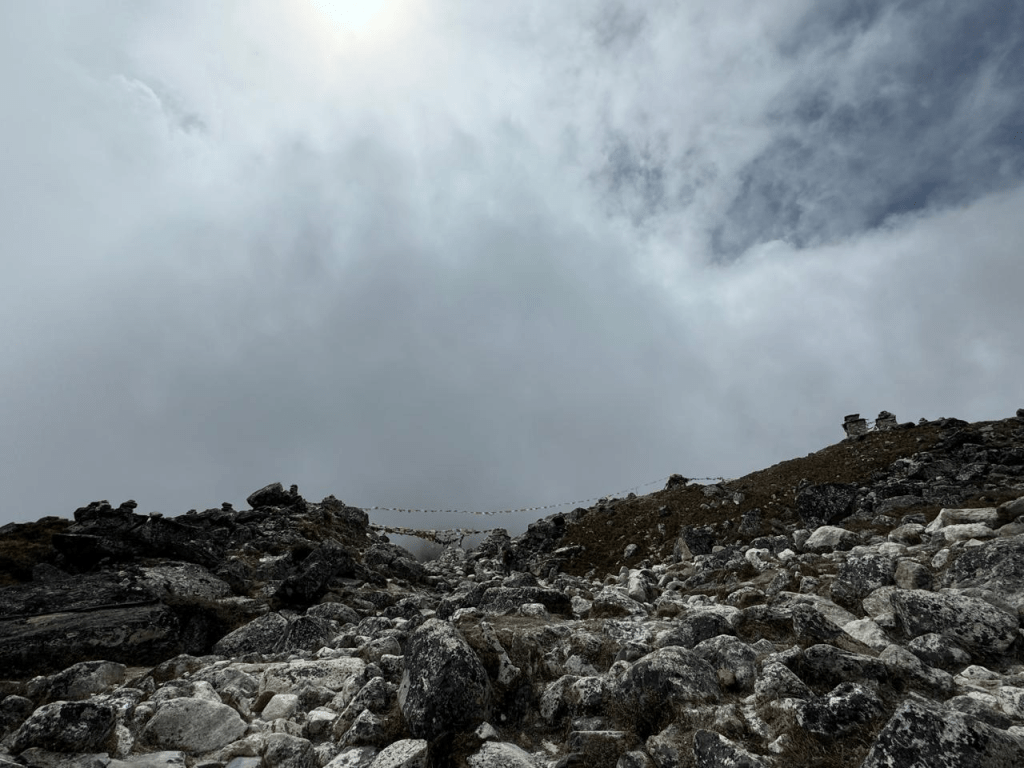
The climb to Thukla Pass was tough, a steep ascent that pushed both our legs and lungs to their limits. Every few steps, I had to stop and catch my breath, the altitude making each movement feel like it required twice the effort. But there was no turning back – the only way was forward. I remember the moment when we finally reached the top of Thukla Pass, my legs trembling with exhaustion but my heart swelling with pride. It was a desolate place, remote and solitary, and I realized where we were now – on a memorial hill dedicated to the climbers who had lost their lives on Everest.
Standing there amidst the stones and memorial plaques, I felt a deep sense of reverence. These were not just mountaineers; these were dreamers, adventurers, people who had given their all in pursuit of something extraordinary. The wind had died down, and the sun was warm on our face, but the gravity of the place made it feel as though the mountains themselves were standing still, paying tribute to those who had come before us. It was a reminder that while our trek was challenging, it was nothing compared to the monumental efforts of those who had scaled Everest itself.
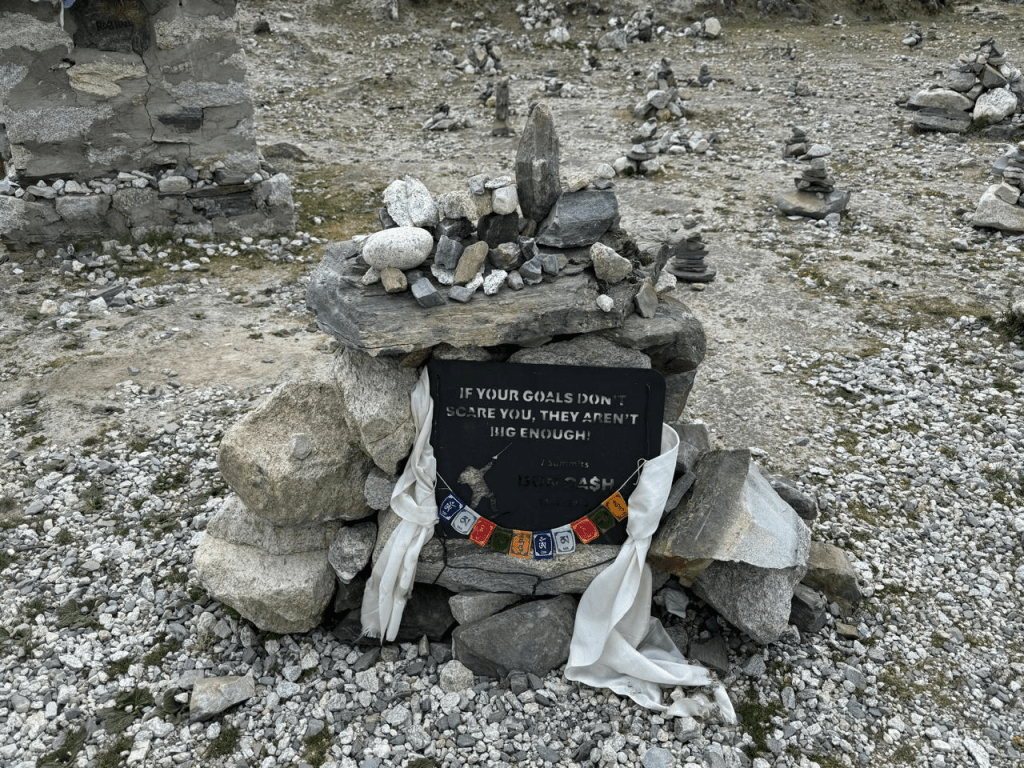
We spent some time at the memorial, each of us lost in our own thoughts. There were no words needed – the silence spoke volumes. As we began our descent from the hill, I felt a renewed sense of purpose. The trek was no longer just about reaching Everest Base Camp; it had become something more, something deeper. It was about understanding the mountain, respecting its power, and connecting with the stories of those who had left their mark on its slopes.
Onwards to Lobuche
The trail beyond Thukla Pass was relatively flat, a relief after the steep climb we had just conquered. The landscape had changed dramatically – we were now in a land of giant mountains, large plains, and rocky paths. The lush greenery of the lower valleys was long gone, replaced by dry, dusty terrain that stretched out before us. There was no vegetation, no signs of life except for the trekkers and the occasional yak caravan making its way up the trail. As we continued on, I found myself marvelling at the vastness of the landscape. The mountains seemed even larger now, towering over us like ancient guardians watching our every step. The path was less defined, and at times it felt as though we were walking through a world untouched by time. There was a wild, untamed beauty to it all – a sense that we were truly in the heart of the Himalayas, far from civilization and everything that was familiar.
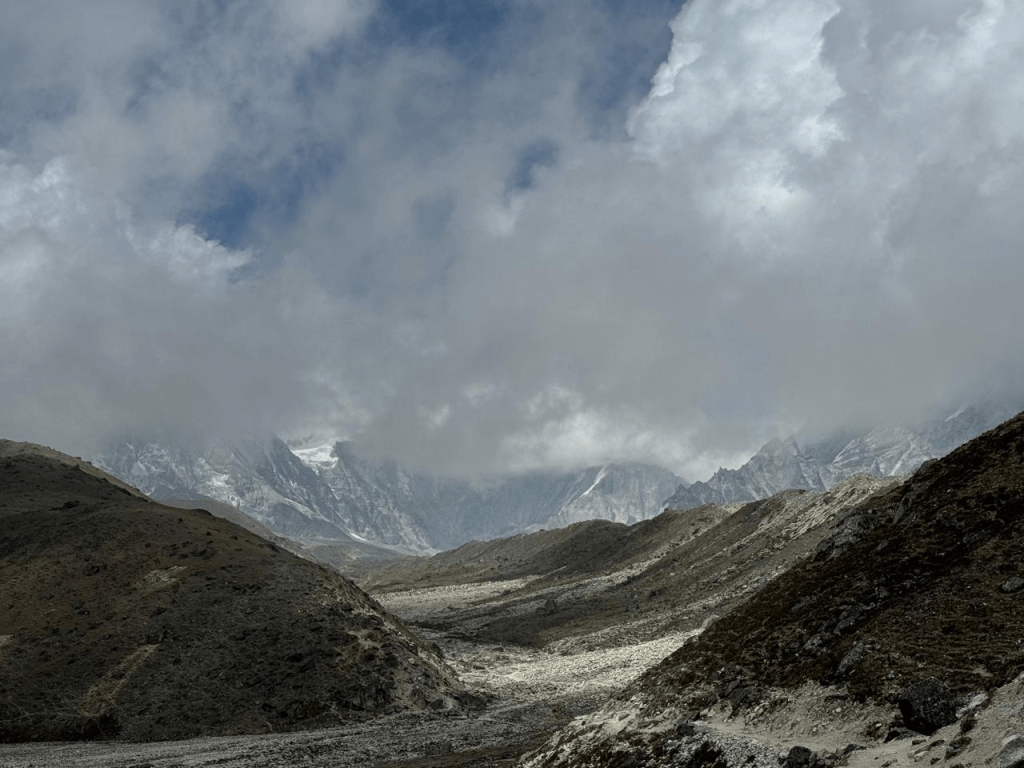
We walked along a river gorge, with the mountains rising steeply on one side and the rushing river far below us on the other. The wind had picked up again, biting at our faces, but the warmth of the Sun kept us going. We stopped frequently to take photos, capturing the breathtaking views that surrounded us. Every angle offered a new perspective, a new appreciation for the sheer scale of the mountains that now felt like old friends. As we neared Lobuche, the terrain became even more barren. The trail was dry and dusty, and the air was thin and cold. The towns were becoming fewer and farther between, and the amenities were growing more basic. It was clear that we were now entering a different phase of the trek – one that required even greater resilience and determination.
Lobuche itself was a small, rugged settlement at 4,930 meters. There were no more suspension bridges or prayer wheels, no more lush greenery or quaint villages. It was a stark, inhospitable place, but it was also incredibly beautiful in its own way. The mountains loomed large around us, their snow-capped peaks glowing in the fading light of the afternoon. There was a sense of isolation here, a reminder that we were now truly in the wilderness.
The Restful Evening
When we finally arrived in Lobuche, we were greeted by the cold, crisp air and the quiet hum of the teahouse. There was a sense of camaraderie as we all were in the common room, sharing stories of our day’s trek. The warmth of the wood-burning stove and the simple, homely furnishings provided a welcome contrast to the harshness of the landscape outside. As I sat there, sipping on a cup of hot ginger lemon tea, I couldn’t help but reflect on the day’s journey. The trek from Dingboche to Lobuche had been one of the most rewarding days of the entire journey as the climb to Thukla Pass, the solemnity of the memorial hill, and the vast, desolate beauty of the trail had all left a lasting impression on me.
As the evening descended and we settled into the teahouse at Lobuche, the reality of the altitude began to weigh on me in unexpected ways. I had already lost my appetite—a cruel twist, considering the energy we needed for the gruelling days ahead. Despite the array of food options, nothing seemed appealing, and I reluctantly settled for a simple dinner of popcorn and tomato soup. It was a stark reminder that up here, at above 4900 meters, even the most basic comforts could feel like luxuries slipping away.

But more than anything, it was the sense of connection – to the mountains, to the people who had come before us, and to the fellow trekkers who shared this path – that stood out the most. Each day on this trek brought new challenges, but it also brought moments of profound beauty, quiet reflection, and deep connection. The journey to Everest Base Camp was far from over, but with each passing day, I felt more in tune with the mountains, more connected to the purpose of the trek, and more grateful for the opportunity to be part of this incredible experience.
Looking Ahead
As the sun dipped behind the towering Himalayan giants, casting long shadows across the vast valley, a sense of anticipation hung heavy in the air. The sky blazed in hues of fiery orange and deep purple, as if the mountains themselves were igniting in a final burst of glory before surrendering to the night. I knew, in the fading light, that an evenly challenging day of our journey lays ahead tomorrow to our target, and we would march onwards towards the legendary Everest Base Camp, testing our endurance and willpower like never before.
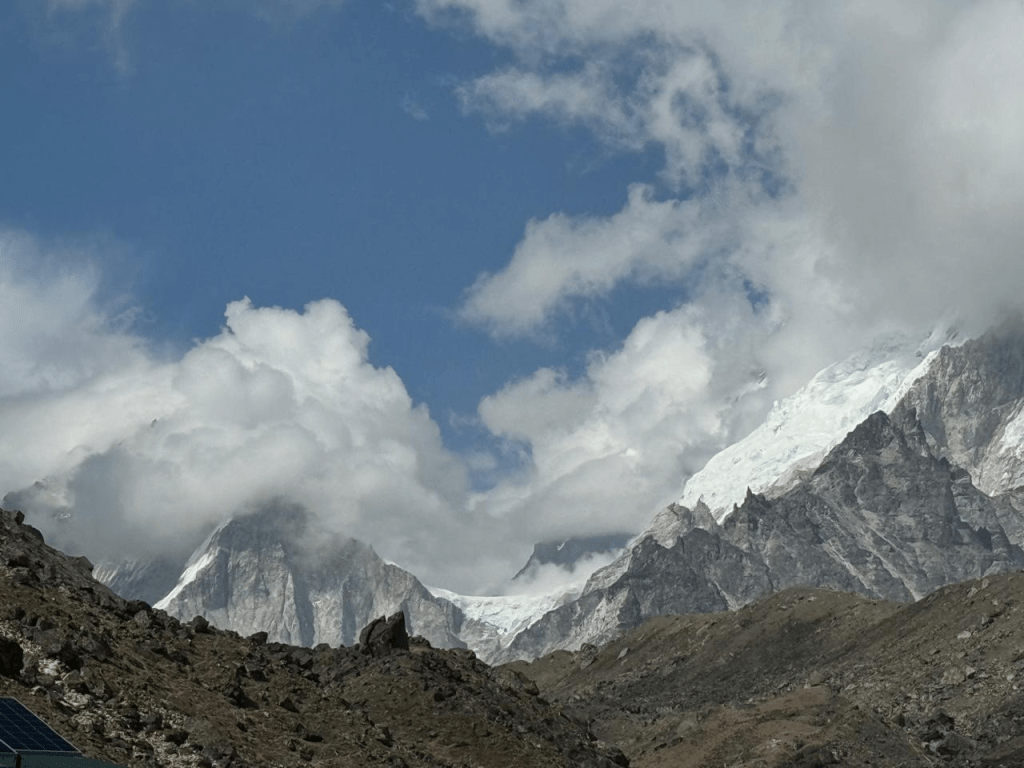
But for this brief moment, time seemed to stand still. The quiet warmth of the teahouse enveloped me, a fragile sanctuary amid the untamed wilderness. Outside, the imposing silhouettes of the snow-clad peaks loomed like ancient sentinels, watching over us in silent reverence. In that stillness, with the mountains standing guard, I felt a rare and profound sense of peace, knowing that while the battle was not yet won, I was exactly where I needed to be.
The trek from Dingboche to Lobuche had been a journey through dreams and desolation, a day filled with both beauty and challenge. And as I lay in my sleeping bag that night, the image of the sunlit peaks of Ama Dablam, Cholatse, and Thamserku lingered in my mind, I knew we were ready for whatever lay ahead. The mountains had tested us, but they had also welcomed us, and we were determined to see this journey through to the end.
— NGarg
 Law And Policy