Waking up in Dingboche was a humbling reminder that we were now deep in the high Himalayas, standing above 4,000 metres where the air was thin and each breath carried the sharp chill of the mountains. Today was our acclimatization day, a vital pause in our journey towards Everest Base Camp, designed to help our bodies adjust to the increasing altitude. The plan was to hike up Nagkartsang Hill, also known as Nagarjun Hill—a demanding climb that would prepare us for the altitude and challenges ahead.
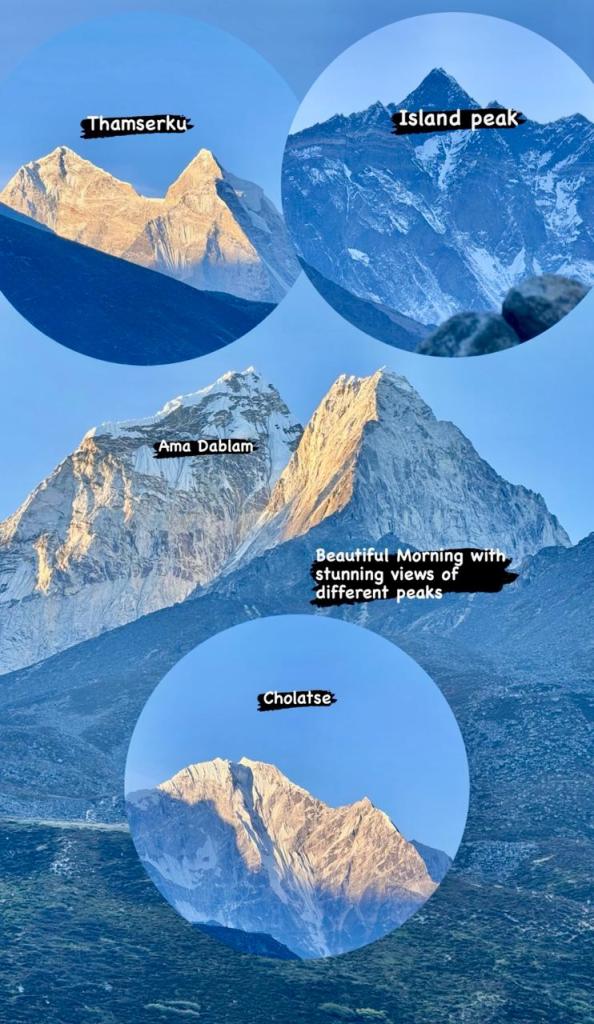
The morning in Dingboche was tranquil, the village nestled in a wide, windswept valley surrounded by towering peaks. As the first rays of the sun touched the snow-covered summits of Ama Dablam, Cholatse, Thamserku, and other Himalayan giants, they glowed in hues of gold and pink, a breathtaking sight that left all of us in awe. Stepping out of the teahouse, I felt a profound respect for the mountains that now surrounded us, aware that we were truly in their domain. It was a quaint village, its stone-walled houses and lodges huddled together as if seeking protection from the relentless winds. The roofs, weighed down with stones, bore testament to the harsh conditions, and yet, the village thrived, powered by solar energy—a testament to the resilience of its people and their ability to adapt to the extreme environment.
The Ascent towards Nagkartsang Hill
After a hearty breakfast, we set off towards Nagkartsang Hill. The path led us through Dingboche, past fields enclosed by stone walls, where yaks grazed lazily. The trail soon began to climb, leading us away from the village and into the rugged terrain of the hill. The ascent was steep from the outset, the path winding up through rocky outcrops and barren slopes dotted with hardy alpine shrubs.
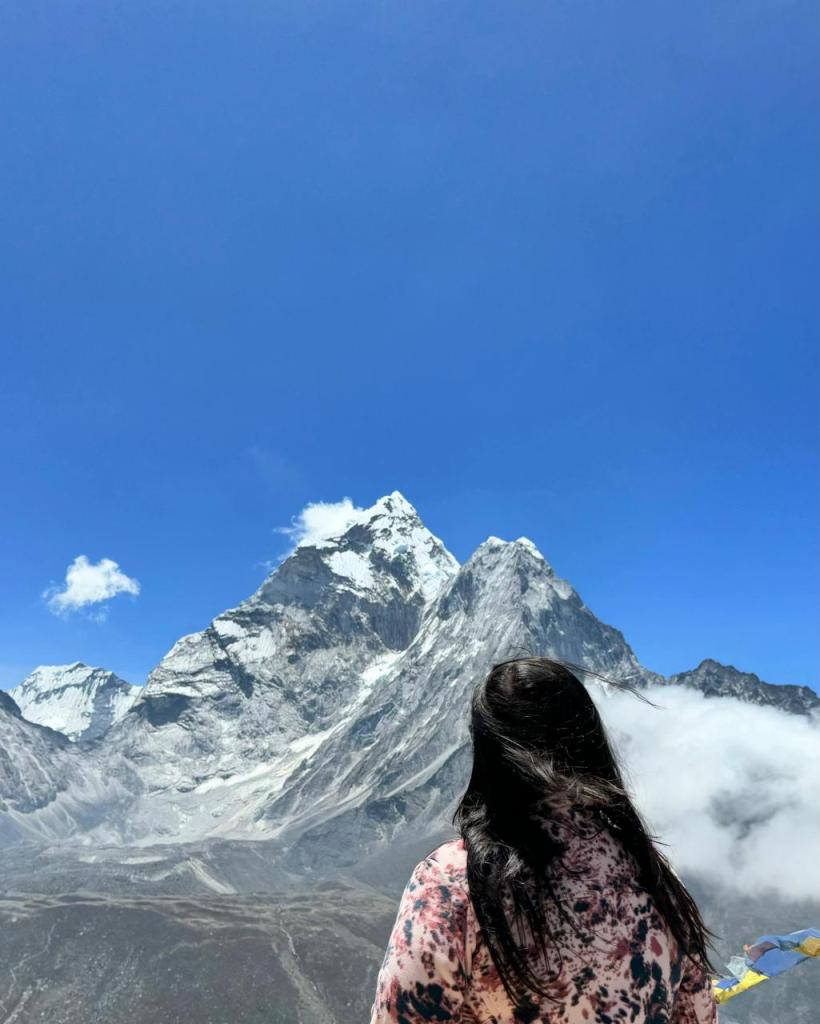
As we set off on our hike, the climb up Nagkartsang Hill was steep and unforgiving, the path winding through rough terrain. With every step, the landscape became more rugged, but the views grew more spectacular. On one side, the river sparkled in the morning sun, its waters flowing from the melting glaciers, snaking its way down the valley, while on the other, the village of Pheriche came into view, another oasis in this high-altitude wilderness, nestled in its own isolated corner of the mountains. We reached a series of flag points along the way, each one marking a small victory in the challenging ascent. I made it to the fourth flag point before deciding to turn back, content with the breathtaking vistas I had witnessed. NP, more determined, pressed on to the top. The higher we climbed, the more expansive the landscape became, offering us panoramic views of the Khumbu region.
Flag Points: Milestones of Resilience
Nagkartsang Hill is marked by a series of five flag points, each a milestone for trekkers aiming to acclimatize. These points serve as goals, urging trekkers to push a little further, climb a little higher. Reaching each flag point felt like a small victory, a testament to our resilience and determination in the face of the challenges posed by the altitude.
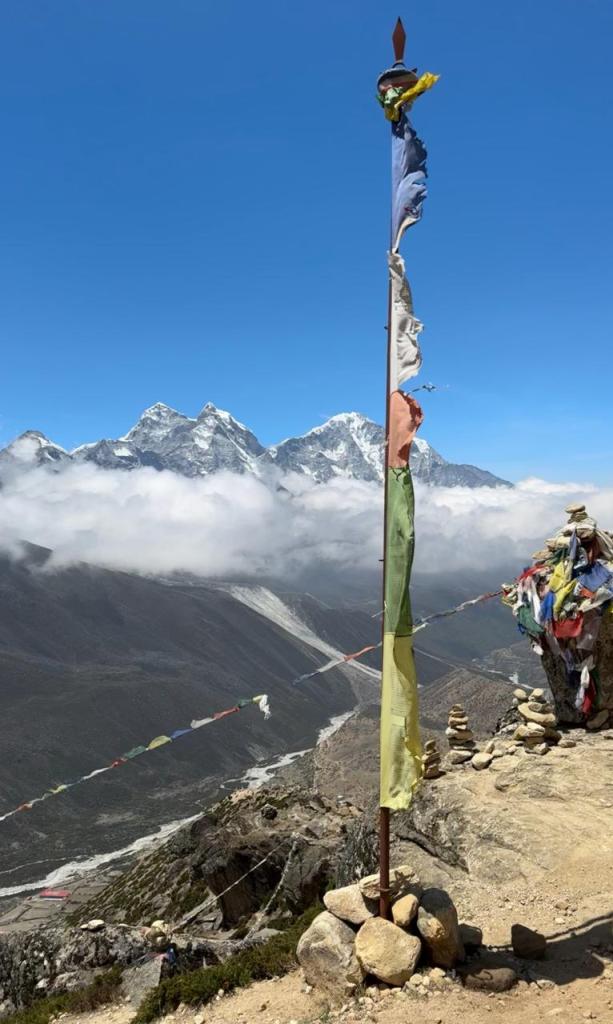
As I made my way towards the fourth flag point, the climb became more demanding. The air was thinner, and each breath felt like an effort. My legs ached with the strain of the ascent, but the views that unfolded with every step made it all worthwhile. From this vantage point, the peaks of Ama Dablam, Cholatse and Thamserku appeared closer than ever, their sharp silhouettes cutting through the clear blue sky. Upon reaching the fourth flag point, I paused to catch my breath and take in the view. It was a moment of reflection—both on the journey we had undertaken so far and on the path that still lay ahead. The decision to turn back at this point was a personal one. I felt content with the effort I had put in and the sights I had witnessed. I knew that pushing myself too hard could be detrimental in such an environment, where the thin air and high altitude demanded respect.
NP, however, decided to continue the climb to the top of the hill. I watched as he pushed on, his was growing smaller as he ascended higher. It was inspiring to see his determination, and I silently wished him strength for the rest of the climb.
The Descent to Dingboche
The descent back to Dingboche was swift, but each step demanded caution on the steep, loose path. As we approached the village, it felt like returning to a warm embrace—the familiar stone walls and the sight of grazing yaks offering a comforting sense of homecoming. The village, with its rugged charm, welcomed us back into its fold, providing a haven of relative comfort amidst the stark wilderness. Back at the teahouse, we rested, our bodies grateful for the reprieve after the afternoon’s exertion.
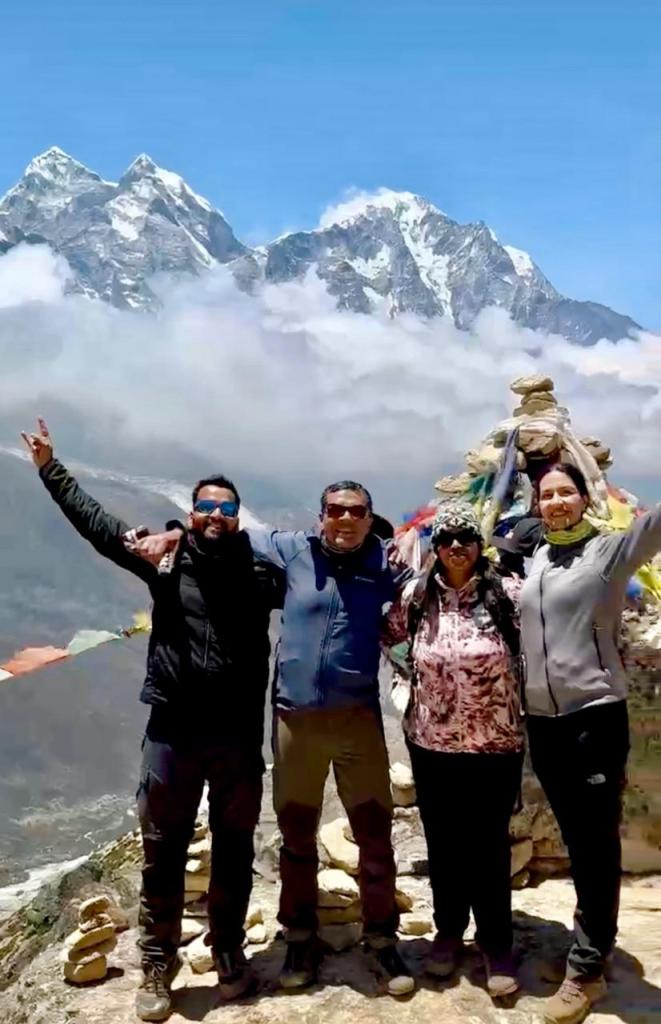
When NP finally returned from his ascent to the top of Nagarjun Hill, we welcomed him with a mix of admiration and relief, his achievement becoming another thread in the fabric of our shared journey. His tales of the summit, accompanied by our porter Gompa, were filled with awe. We listened intently as he described the mysterious magnetic point and the glittering glacier spots that dotted the landscape. As he spoke, the simple act of sharing pistachios at the peak became a symbol of the small joys and bonds formed in the face of such immense challenges. The rest of the day unfolded in quiet reflection within the cozy confines of the teahouse. We were the only five trekkers staying there, which lent the place an intimate, almost familial atmosphere. The common room, with its wooden and simple furnishings, became our sanctuary—a stark contrast to the harsh, untamed landscape outside. It was a place where we could relax, share stories, and bond over the shared trials and triumphs of the trek.
As the afternoon wore on, I found myself lost in thought, reflecting on the journey thus far. The trek to Everest Base Camp is not just a physical challenge; it’s a profound mental and emotional journey as well. Each day presents new obstacles to overcome, new heights to conquer, but it also offers moments of breathtaking beauty and deep connection. The climb up Nagkartsang Hill had been a gruelling test of endurance, yet it also served as a powerful reminder of why we were here—to push our limits, to immerse ourselves in the awe-inspiring grandeur of the Himalayas, and to discover something deeper within ourselves. In that quiet moment, surrounded by the warmth of the teahouse and the company of fellow trekkers, I felt a deep sense of gratitude. The mountains had a way of stripping away the noise of the world, leaving only the raw essence of the journey—a journey not just across the physical terrain, but within the landscapes of our own hearts and minds.
As the day drew to a close, the sun dipped behind the towering mountains, casting long, melancholy shadows over the valley. The temperature plummeted, a sharp reminder of the unforgiving environment we were in. The lively conversations that had filled the day gradually faded, giving way to a comforting silence as we retreated into our rooms after dinner. The acclimatization day in Dingboche had been more than just a pause in our physical journey—it was a necessary moment of introspection and preparation, a chance to gather our strength for the challenges that still lay ahead.
Lying in my bed that night, the image of the sunlit peaks of Ama Dablam, Cholatse, Island Peak, and Thamserku danced in my mind, their beauty etched into my memory. The serene yet formidable presence of these mountains seemed to speak to something deep within me. Tomorrow would undoubtedly bring new obstacles, but with each passing day, I felt a growing connection to these ancient giants, a bond forged through shared struggle and silent admiration.
The journey to Everest Base Camp was far from over, and the path ahead promised both difficulty and wonder. Yet, as I drifted into sleep, I realized that this trek was no longer just about reaching a physical destination. Day 6 had been a day of acclimatization, not just to the altitude, but to the rhythms of the mountains and the quiet, persistent strength they demanded. It was a day that deepened my resolve and my understanding of the journey itself—one that was as much about discovering the vast landscapes within as it was about conquering the heights outside.
— NGarg
 Law And Policy